
[[{“value”:”
The Trump administration has cleared semiconductor giants Nvidia and Advanced Micro Devices (AMD) to resume sales of certain artificial intelligence chips to China — on the condition that the U.S. government receives 15 percent of the revenue from those sales.
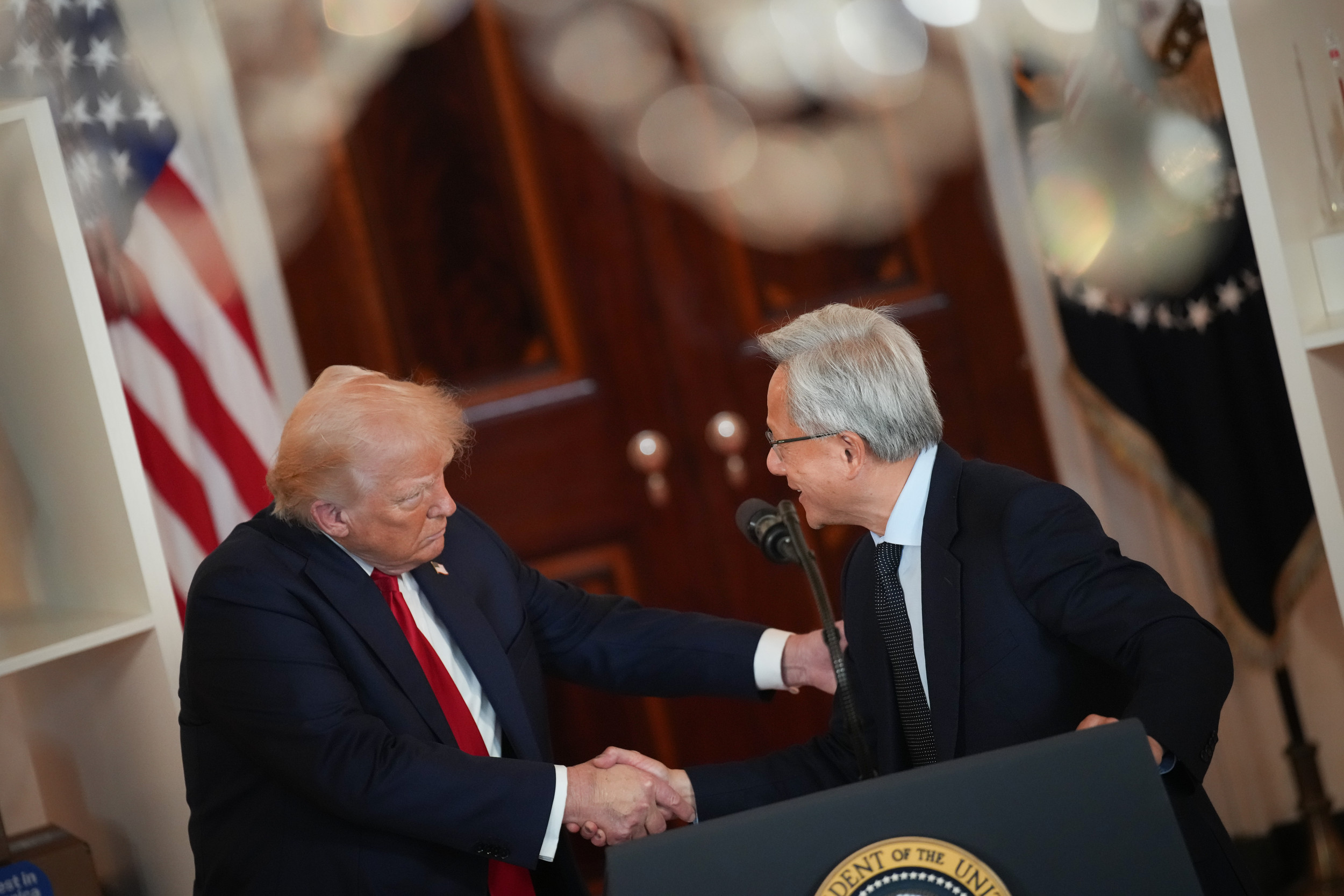
The unusually structured deal followed a White House meeting last week between Nvidia CEO Jensen Huang and President Donald Trump. Licenses were issued two days later.
“We follow rules the U.S. government sets for our participation in worldwide markets,” Nvidia said in a statement, adding that it hoped the policy “will let America compete in China and worldwide.”
AMD did not immediately respond to Newsweek for a request for comment.
Under the agreement, confirmed by officials and company statements, Nvidia’s H20 and AMD’s MI308 processors — less powerful versions of their top AI processors — will be licensed for sale in China.
From Ban to Revenue-Sharing
In April, the Trump administration extended Biden-era export controls to block even these downgraded chips. Those rules built on 2022 restrictions designed to prevent exports of high-performance processors that U.S. officials feared China could use to aid its military.
By June, Trump signaled a policy shift was coming after meeting with Huang. The administration announced in July that sales could resume, but licenses were only granted once the 15 percent payment condition was in place, the Financial Times first reported.
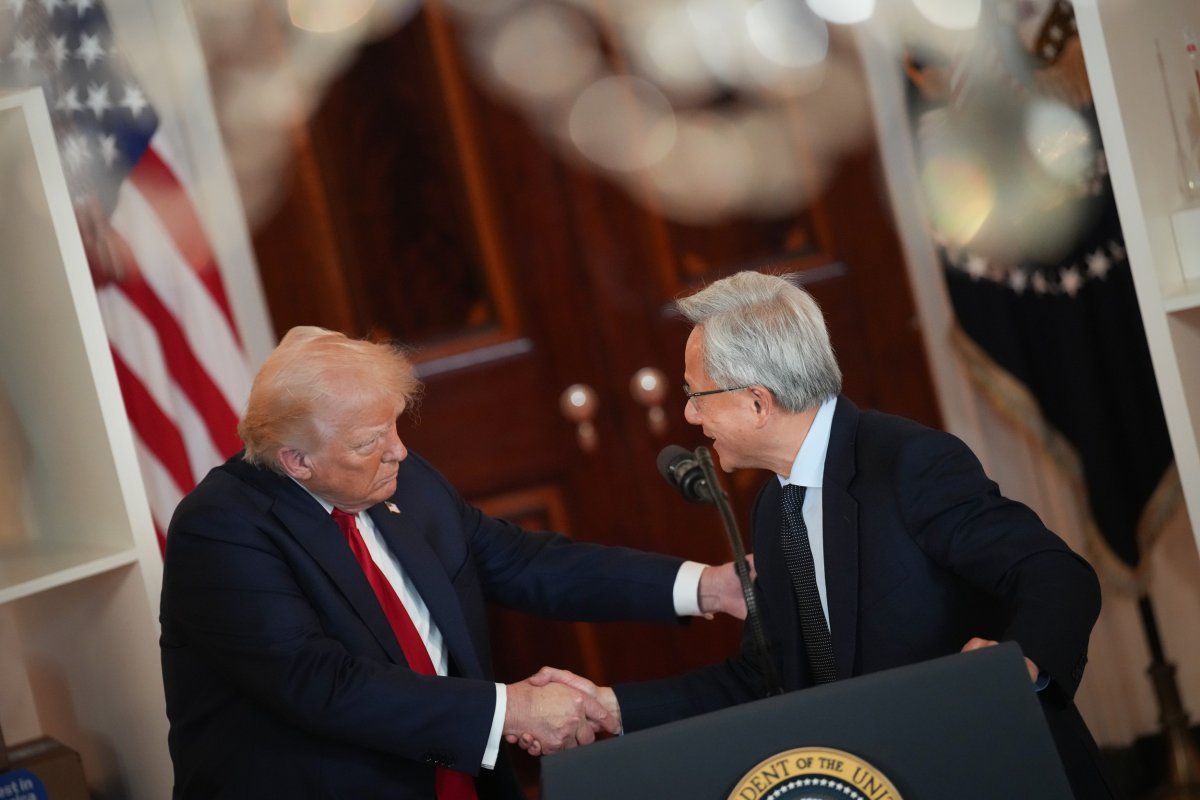
U.S. President Donald Trump shakes hands with Nvidia CEO Jensen Huang after Huang delivered remarks in the Cross Hall of the White House during an event on “Investing in America” on April 30, 2025 in Washington, DC.
Photo by Andrew Harnik/Getty Images
“This is unprecedented,” Deborah Elms, a Singapore-based trade policy expert, told the BBC. No American company had ever been required to hand over a share of revenue to secure an export license.
Analysts at Bernstein Research estimate Nvidia could sell about 1.5 million H20 chips in China this year, bringing in some $23 billion in revenue. A 15 percent cut could yield the U.S. government more than $3 billion.
Security or Strategy
Some U.S. lawmakers and security officials warn that even limited AI chips could strengthen China’s military and surveillance capabilities. “Beijing must be gloating to see Washington turn export licences into revenue streams,” said Liza Tobin, a former National Security Council China director, in comments to the Financial Times.
Representative Raja Krishnamoorthi, the top Democrat on a House panel focusing on competition with China, also raised concerns over the reported agreement, calling it “a dangerous misuse of export controls that undermines our national security.”
“Chip export controls aren’t bargaining chips, and they’re not casino chips either. We shouldn’t be gambling with our national security to raise revenue,” he told the Associated Press.

A NVIDIA chip is displayed at the NVIDIA booth during the China International Supply Chain Expo (CISCE) in Beijing on July 16, 2025.
Jade Gao/AFP via Getty Images
Nvidia disputes that the H20 poses military risks and denies Chinese state media claims that its chips contain “backdoors” or “kill switches.”
Commerce Secretary Howard Lutnick said the chip licenses are linked to talks with Beijing over rare-earth minerals, a sector dominated by China. The deal also comes as a U.S.-China trade truce that reduced triple-digit tariffs nears expiration.
In some ways, the structure of the deal resembles Trump’s June approval of Nippon Steel’s purchase of U.S. Steel, which gave the U.S. government a “golden share” in the company. In both cases, corporate approvals were tied to financial returns for Washington.
Asked about the deal on Monday, President Trump said he might allow Nvidia to sell a scaled-down version of its most advanced AI chip, the Blackwell, to China. He said he would consider it if the company cut its performance by 30 percent to 50 percent.
A Precedent in Question
Yet critics say the move risks turning export controls from a security tool into a revenue generator. “Turning export controls into a 15 percent revenue tax changes their purpose,” one former U.S. security official told the Times.
Some warn it sets up “pay-to-play” licensing and may raise constitutional questions, since the Constitution bars taxes on exports. The administration calls the 15 percent payment a licensing condition, not a tax.
For Nvidia and AMD, the agreement reopens access to a market projected to spend $100 billion on AI this year — but with lower profit margins and heightened political scrutiny. For Beijing, it could mean renewed access to technology it needs without having to invest in building out that tech domestically.
As one trade adviser told the BBC: “The message this sends is that national security has a price — and in this case, it’s 15 percent.”
What is a Blackwell chip?
Blackwell is Nvidia’s newest generation of graphics processing units (GPUs), launched in 2024 to replace its Hopper line. The chips are faster, more energy efficient, and built for advanced AI work such as training large language models, running complex algorithms, and powering generative AI.
Because of their high performance, Blackwell chips are subject to U.S. export controls that limit sales to China and certain other countries over national security concerns.
Update 8/11/25, 2:18 p.m. ET: This article was updated with additional information.
“}]]