
[[{“value”:”
Local News
April 24, 2026 / 6:02 PM EDT
/ CBS Boston
Add CBS News on Google
Artificial intelligence works when computers learn from data that is readily available. But there is no data to teach robots to do simple human tasks. It needs to be created.
That’s what MIT graduates Josh Gruenstein and Alon Kosowsky-Sachs are working to build. The pair co-founded Tutor Intelligence out of MIT’s Computer Science and Artificial Intelligence Laboratory (CSAIL).
“Most people live their lives and never see a robot. That’s going to change really quickly,” said Gruenstein, co-Founder and CEO of Tutor.
Kindergarten for robots
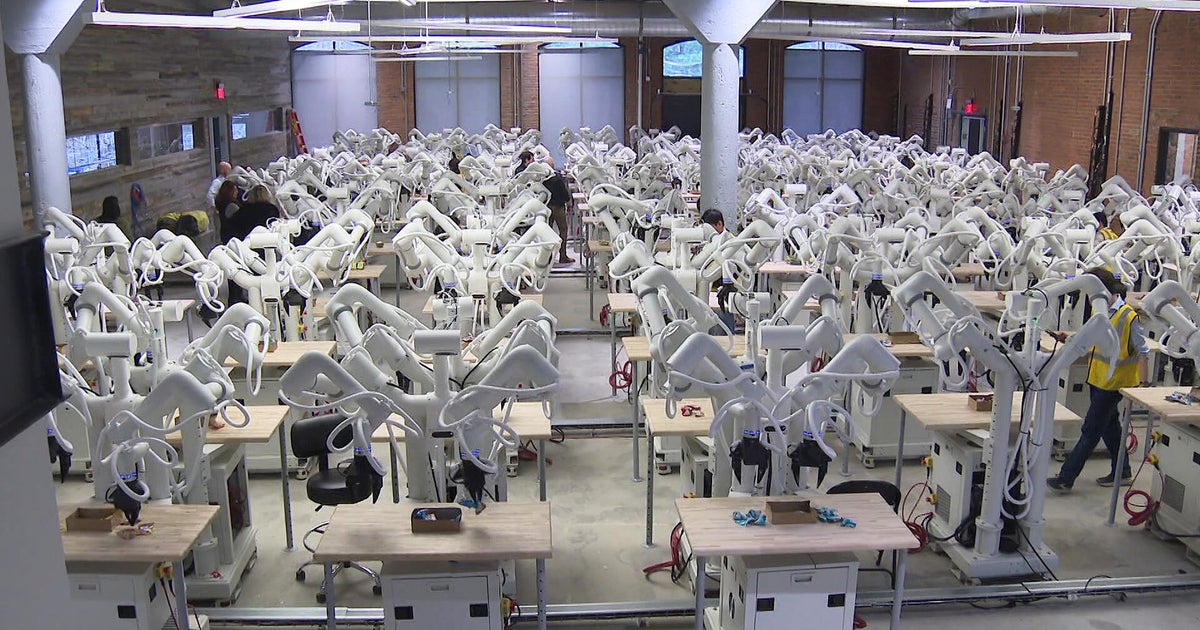
They now host the largest robot data factory in the United States, located in Watertown, Massachusetts. Gruenstein describes it like a kindergarten for robots.
“These robots are doing really basic tasks. They’re picking up individual items, putting them into boxes, trying to fold laundry,” Gruenstein said.
The robots are in their early stages of development. So they mess up quite a bit. They certainly aren’t doing these tasks perfectly-at least not yet. That’s because the data for AI to learn a variety of physical human tasks doesn’t exist.
“The way that models like ChatGPT work is you read all of the books that have ever been written and all of Wikipedia and all of social media, and then you can engage in conversation like a human,” Gruenstein said. “For robotics, we don’t have that source of data. We have to go get it.”
But we know there are some robots doing pretty advanced stuff. So why are these ones in kindergarten class?
“It’s very easy to build a robot that does one job over and over again very well, right?” Gruenstein said. “If you think about a car factory … it’s robots that are doing the exact same motion every single day, because that car isn’t going to change day-to-day. But most physical work doesn’t look like that.”
Can robots learn new tricks?
At the heart of this challenge is raising robots that can learn any behavior in any situation. Adapting – like a human would.
“For robots to do all of the jobs and kind of engage with our world in the same way that humans do, they have to be able to learn new skills on the fly, and kind of be general to any environment that they might learn in,” says Gruenstein.
Until then, they are literally creating the data that they will be trained on, alongside 100 of their closest robot friends.
And they won’t be clumsy kindergarteners forever.
“At the rate at which this technology’s advancing that’s going to charge really quickly,” Gruenstein said. “I think within the next five years, you won’t be able to go through your normal day-to-day life without seeing a robot. And I think that’s gonna be a really fascinating and exciting technological and social shift.”
More from CBS News
In:
Artificial Intelligence
Watertown News
© 2026 CBS Broadcasting Inc. All Rights Reserved.
Featured Local Savings
“}]]