
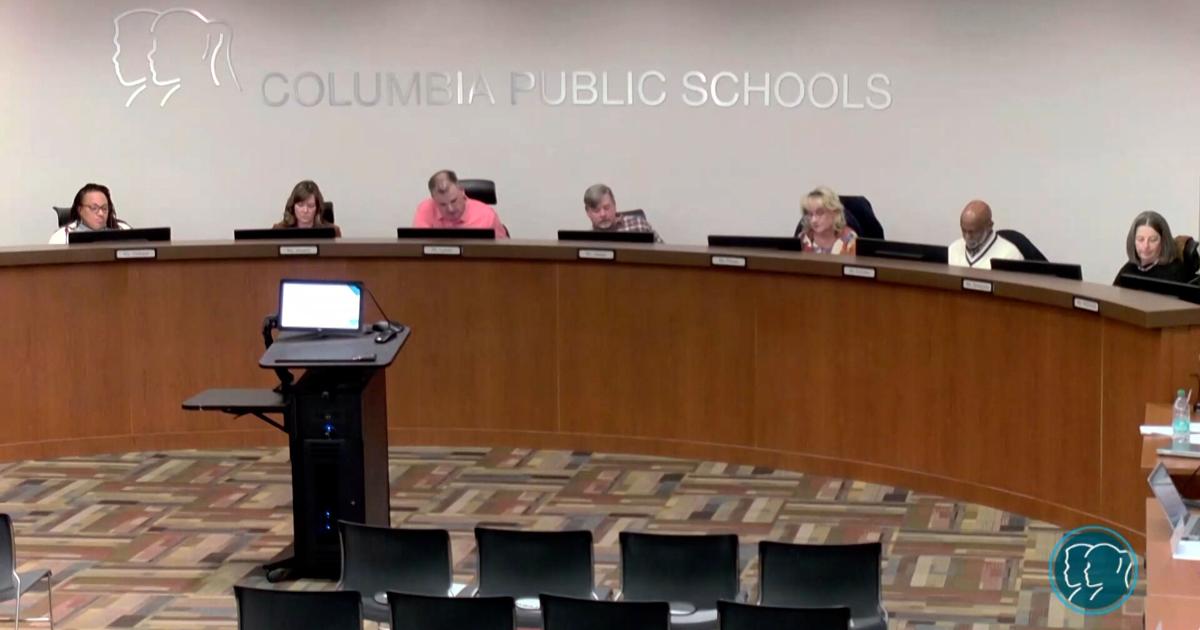
COLUMBIA — The Columbia School Board approved an artificial intelligence policy and regulations for both students and employees at Monday’s regular meeting. Columbia Public Schools will also be adding a new district-wide “AI Coordinator” position.
The AI policy was presented in early 2024 but was not adopted at that time. Board Vice President Paul Harper said the policy has since been revised for clarity and relevance because of the continuing changes of AI.
“We all know AI is not going away, and from the board level we need to have a policy that sets forth what what we can expect from the administration with regard to that issue,” Harper said.
The changes to the policy focus on generative AI, a subset of artificial intelligence that uses sophisticated data models to generate text, images, videos or other forms of data. This includes platforms like ChatGPT, Google Gemini and Canva AI.
The policy also prompted anyone using resources that include AI, especially where generative AI is increasingly prevalent, to consider looking for privacy and security options the settings.
“I think the biggest risk, quite frankly, is that our data leaves the district, and we’re always concerned with ensuring that our data remains secure,” Harper said.
The district said it will update parents/guardians annually with a summary of AI use in the district, including any significant changes to the AI use plans. The district is also set to train employees and students on the requirements, other district policies regarding data management and privacy, acceptable uses of AI, and AI prohibitions.
AI use plans
An AI “use case,” as laid out in the policy, is a specific situation or problem where artificial intelligence can be applied to solve the problem, improve efficiency or create value.
The AI use plans will provide a detailed set of rules for acceptable AI use in the district that may be regularly updated as new issues emerge.
The purpose of each AI use plan, according to the policy, is to protect the safety and security of students, employees and the district while allowing for appropriate educational and productive enhancements enabled by generative AI.
“(The) student education educational records we have here, (are) highly regulated through FERPA and other laws,” Harper said, “So we need to make sure we’re always in compliance with those laws.”
AI Coordinator(s) and AI use plans for generative AI
The policy also called for the superintendent to designate at least one district AI coordinator who will be responsible for regulating, monitoring and adjusting AI use in the district and developing the district’s AI Use Plan. The AI coordinator(s) will also serve as a professional resource and advisor for the district on these topics.
Employees and students can submit requests for new AI uses to the AI coordinator, according to the procedures outlined in the AI Use Plan.
According to the district, the AI coordinator must be knowledgeable of the contents of Use Plans and has to direct a careful and informed consideration of the privacy policies of all AI products and services including any relevant changes to the policies.
The policy also included that once a school year, the AI coordinator will review the district’s AI usage for safety, data privacy, appropriateness and effectiveness.
“What the policy does is it essentially set for an outline of what we expect the administration will use,” Harper said. “That there will be an AI plan that will be regularly reviewed by our AI coordinators so that we are constantly keeping up on an ever changing landscape,” Harper said.
Policy Definitions
The policy also listed the following definitions to apply to all of the district policies and procedures relating to AI:
Artificial Intelligence: Any hardware or software capable of adapting its output or performance by applying probabilistic algorithms to input. For the purposes of the policy, any product or service that contains or uses AI, is marketed as AI, or is marketed as using or containing any kind of AI will also be defined as AI when the AI component is used.
Confidential Data/Information: Information that the district is prohibited by law, policy, or contract from disclosing or that the district may disclose only in limited circumstances. Confidential data includes, but is not limited to, personally identifiable information about students and employees, student and employee medical information, student education records, and information about any student’s individualized education program or Section 504 plan.
Critical Data/Information: Information that is essential to district operations and that must be securely maintained to avoid disruption to district operations.
Operational generative AI: Resources and uses of generative AI for narratives, recommendations, predictions, communication drafts, and the like based on nonconfidential data inputs.